top of page

Connect to the Universe

We invite you to become a part of our local astronomy community!

Looking Through Telescope

Our  Mission

The Franklin Township Astronomy Club is your gateway to amateur astronomical exploration. Based in Franklin Township, NJ, we work to bring together a community of people who share a common interest in learning about the universe

Next Events

  • Fri, May 29
    1091 Canal Road Princeton (Griggstown), NJ 08540, USA
    May 29, 2026, 7:30 PM – 11:30 PM
    1091 Canal Road Princeton (Griggstown), NJ 08540, USA
    Club members have access to one of the darkest sites in Franklin Township every Friday night, when conditions are favorable. Members are invited to bring their cameras, binoculars, telescopes. If you don't have anything to observe with, come learn from others!
  • Wed, Jun 03
    Franklin Township Community/Senior Cente
    Jun 03, 2026, 7:30 PM – 9:00 PM
    Franklin Township Community/Senior Cente, 508 Demott Ln, Somerset, NJ 08873, USA
    Join us on the 1st Wednesday of every month in the Franklin Township Community/Senior Center at 7:30 pm

Celestial Events Calendar

Latest News

Thanks to all who participated in our Dark Sky Week activites in April!

For all of us who love looking deep into the night sky, one of the more troubling developments is the creeping loss of darkness. With continued population growth and land development, we are losing darkness at a rate of 2% per year. In fact, it’s estimated that only 2 in 10 people in the United States can see the Milky Way at night.


The Franklin Township Astronomy Club is committed to raising awareness of the impact of artificial light at night on our environment. We will be participating in a number of public events this month:


April 13-20 Township-wide commemoration of International Dark Sky Week: With the support of the Franklin Township Environmental Commission,  the Township Council issued  a proclamation in support of International Dark Sky Week from April 13-20. Our Club is proud of this accomplishment and grateful for Franklin Township’s support of this global observance

April 18: “Go Dark” sunset hike and astronomy night: Together with our club sponsor, the Franklin Township Trails Advisory Committee, we partnered on a combined hike and observing night.  Although clouds prevented a night of viewing, we were able to share in a discussion and Q&A about our telescopes and the way we both view and photograph the night sky.


April 22, Preserving Franklin’s Night Sky presentation at the Franklin Township Public Library. Club member Ron Urioste presented an overview on ways we can all contribute to reducing the impact of artificial light at night on our health and environment. For ways in which you can become involved in the Dark Sky movement, check out www.darksky.org


NEW DATE!!! SATURDAY < MAY 16  Wagner Farms Arboretum Astronomy Night: a small group of club members is joining with a larger group of amateur astronomers as we set up telescopes during this amazing night under the stars. Open to the public, we’d love to see you there! Wagner Farms Arboretum 97 Mountain Ave, Warren, NJ

Wagner_May-16-2026.jpeg

Monthly Meeting

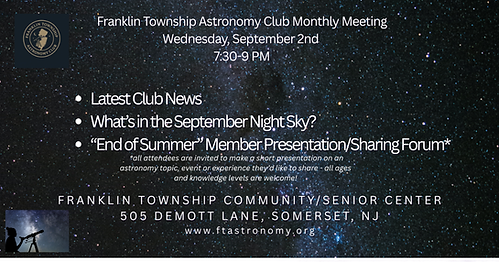
Don't forget our meetings are set for a new day, time and location for 2026!

Beginning in January, we are moving our monthly meetings to occur on the first Wednesday of each month, at 7:30 pm in the Franklin Township Community/Senior Center (505 DeMott Lane, Somerset, NJ)

Our May meeting agenda is set! Aside from Club News, and an overview of what's in the night sky in April, we will open up our meeting to a review of our plans for the summer months, and invite our member attendees to share their ideas for events and activities as we prepare to move the club into the second half of the year. And if the skies are clear, we'll invite you to bring your binoculars and telescopes outside to do some observing!

May we invite you to our May meeting? Join us on Wednesday, May 6th at 7:30 pm!


Copy of FRANKLIN TOWNSHIP ASTRONOMY CLUB.jpg

Meteor Shower Watch


Late April and May brings us the the Eta Aquariids. Although this is best viewed from the southern hemisphere, if you happen to be in the southern states at this time of the month, you might have a chance to see them as well.


When to watch: The best morning to watch is May 5, 2026, in the hours before dawn. The American Meteor Society is listing 3:51 UTC on May 5 as the shower’s predicted** peak time. The fact is that the peak of this shower stretches out over several days. So you can expect elevated numbers of meteors a few days before and after the peak time. The mornings of both May 4 and May 6 are also good times to watch!
Nearest moon phase: The last quarter moon will fall at 21:10 UTC on May 9.  There will be a waning gibbous moon in the post-midnight sky, that sets after sunrise. The sky before dawn on the mornings around the predicted peak for the 2026 Eta Aquariids will compete with a bright gibbous moon. Find a way to block out the moon for a better view of the sky.


The radiant: will rise in the wee hours, climbing toward its highest point at dawn. That’s why the hours before dawn will be the best time to watch this shower.


Duration of shower: April 15 to May 27. This time period is when we’re passing through the Eta Aquariid meteor stream in space!
Expected meteors at peak, under ideal conditions: The zenithal hourly rate (ZHR) of this shower (the rate at the shower’s peak, under a dark sky, with no moon, when the radiant is high in the sky) is 60. In 2026, a waning gibbous moon will severely affect this shower, reducing hourly rates. And be aware that the shower is best for latitudes like those in the southern half of the U.S. or even farther south, in the Southern Hemisphere. These are swift meteors that produce a high percentage of persistent trains.


Note: The Eta Aquariids’ radiant will be on the ecliptic, which will ride low in the sky on spring mornings as seen from far northerly latitudes. This shower favors more southerly latitudes (like those in the southern U.S. or the Southern Hemisphere), where the radiant appears higher in the morning sky. It’s often the Southern Hemisphere’s best meteor shower of the year.

John Clyde Preserve
Current Observation Conditions 

John Clyde Memorial Grasslands Preserve is our Club's official dark sky observing site. Open by permission from Franklin Township for Club Members, the preserve is an important resource for observing and photographing the night sky.  The tables below provide real-time summaries of sky and weather conditions at the Preserve. To learn more about John Clyde Preserve, click here
bottom of page